
Severe drought and heat in the central amazon turned Lake Tefé into a shallow spa, killing fish and endangered river dolphins. Photo Credit: Miguel Monteiro
In late 2023, as the Amazon’s central region faced one of the most severe droughts in recorded history, Lake Tefé—a vast flood-plain lake—became the site of a grim discovery. Dozens of endangered dolphins were found dead along its shores. Scientists determined that extreme heat, rather than pollution or disease, was the likely cause—a phenomenon never before documented in freshwater environments.
While the world’s attention has largely focused on record ocean and air temperatures, researchers from the University of California, Santa Barbara (UCSB) have uncovered an equally troubling trend beneath the surface of the Amazon’s freshwater lakes. Their new study, published in Science, reveals unprecedented warming across the basin’s flood-plain lakes and links it directly to climate change, raising serious concerns for both ecosystems and human communities.
Among the study’s leading scientists are John Melack and Sally MacIntyre, professors at UC Santa Barbara and principal investigators at the university’s Marine Science Institute (MSI). Both have spent decades studying how aquatic ecosystems respond to environmental stress. “Freshwater systems are often overlooked in discussions of global warming,” said MacIntyre. “Yet the changes we’re seeing in the Amazon are unlike anything we’ve observed before.” Melack added that these lakes serve as “natural sensors of climate change,” warning that the Amazon’s capacity to withstand environmental disruption is reaching its limit.
The Amazon’s lakes are not just reflecting climate change; they’re amplifying its signals. If we want to protect these ecosystems and the people who depend on them, we must listen to what they’re telling us.
During the 2023 drought, Lake Tefé’s surface area dropped from roughly 379 square kilometers to about 95, leaving shallow waters less than half a meter deep that heated rapidly under intense equatorial sun. The lake’s surface temperature soared beyond 40 °C (104 °F), far above the typical 29–30 °C range found in similar tropical lakes. Under normal conditions, deeper layers of water offer cooler refuges for aquatic life, but according to Ayan Fleischmann of Brazil’s Mamirauá Institute, “in the extreme drought of 2023, this refuge simply did not exist.” With no escape from the heat, many aquatic species—including the region’s iconic pink river dolphins—succumbed to lethal temperature stress.
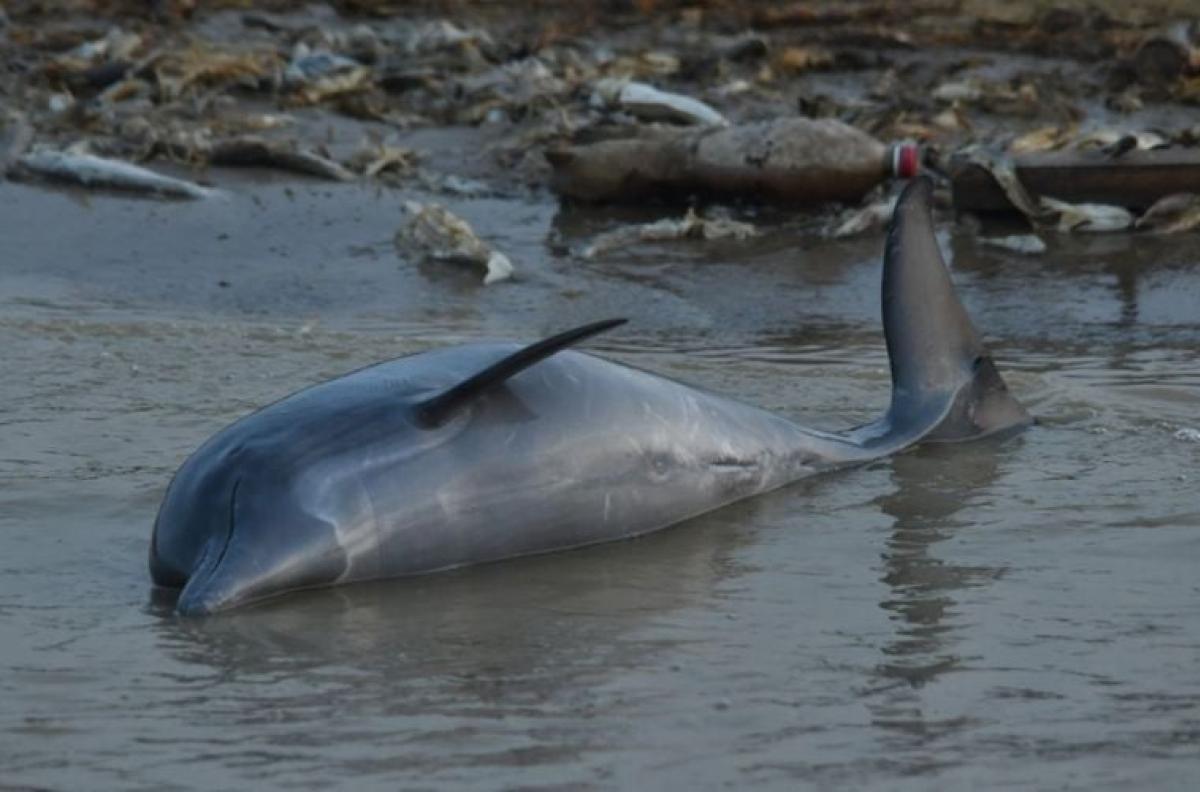
This tucuxi was one of more than 200 dolphins that perished in Lake Tefé during the unprecedented 2023 drought and a heat wave. Photo Credit: André Zumak / Mamirauá Institute
Satellite observations from 1990 to 2023 across 24 Amazon flood-plain lakes reveal consistent warming of roughly 0.6 °C (1.1 °F) per decade, with some lakes heating even faster. The record-breaking conditions of 2023 and 2024 suggest these extreme events are no longer isolated anomalies but part of an accelerating trend driven by global climate change. Melack and MacIntyre note that several factors amplify the heat: reduced rainfall and cloud cover, shallower water that absorbs more sunlight, and unusually calm winds that limit surface cooling. “We are concerned that these conditions are becoming more common,” said Melack. “The implications for biodiversity and local communities are profound.”
The crisis is not confined to wildlife. As rivers and lakes shrink and overheat, fisheries collapse, transportation routes disappear, and isolated riverine communities lose access to food, clean water, and medical care. MacIntyre emphasized that “the environmental and humanitarian dimensions of this problem are tightly linked,” showing how climate-driven changes in ecosystems directly affect human survival.
The UCSB researchers stress the urgent need for sustained, long-term monitoring of Amazonian lakes—programs that are rare but essential for understanding and responding to these changes. “The Amazon’s lakes are not just reflecting climate change; they’re amplifying its signals,” Melack said. “If we want to protect these ecosystems and the people who depend on them, we must listen to what they’re telling us.”
Adapted from original reporting by Harrison Tasoff, “Hotter Than Your Average Spa: Rising Temps in Amazon Lakes Sound Alarm Over Climate Change,” The Current, UC Santa Barbara, 2025.