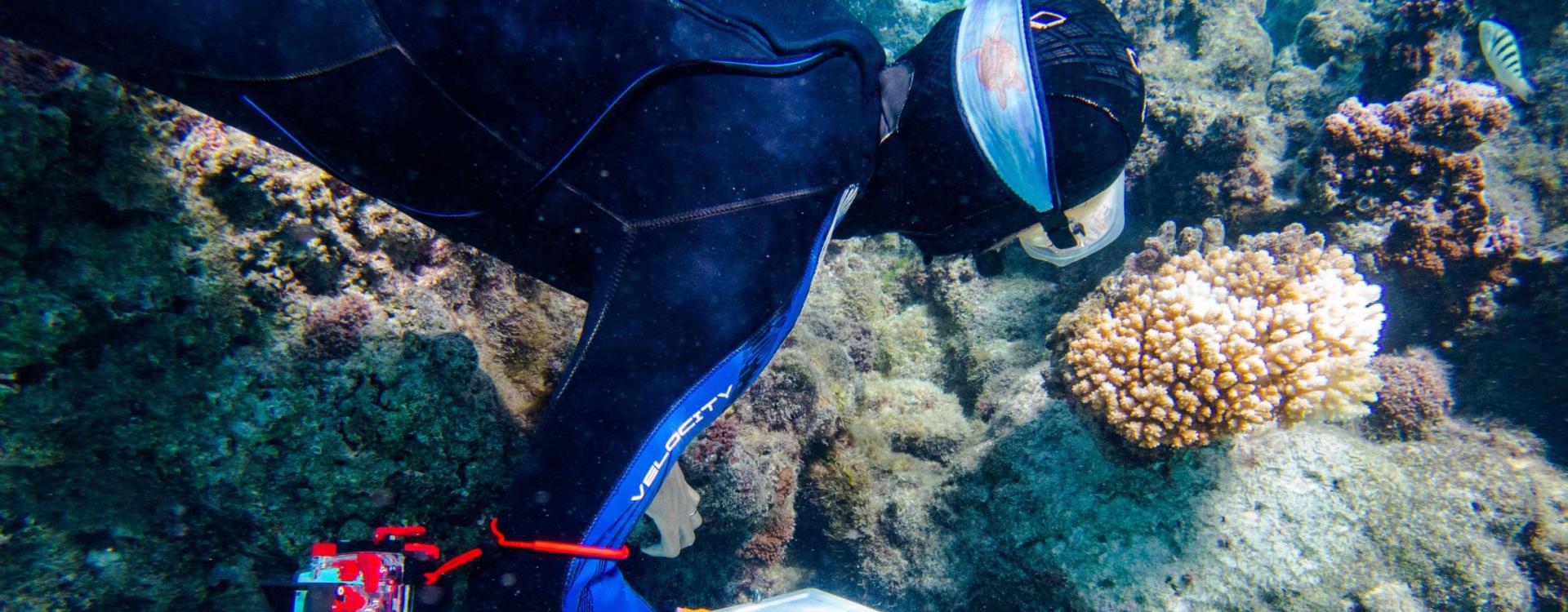
Professor Deron Burkepile observes coral in the process of bleaching in the reefs around Moorea. Photo Credit: Jeff Liang
From The Hill
In a new compelling op-ed on The Hill, Dr. Rebecca Vega Thurber, Director of the Marine Science Institute and Professor of Ecology, Evolution, and Marine Biology at UC Santa Barbara, pushes back firmly against climate change denial, including President Trump’s repeated claims that it's a “hoax” or “con job.” As a scientist who never set out to study climate change, Thurber shares how her own data forced her — and hundreds of other researchers — to face an undeniable truth: rising global temperatures are devastating marine ecosystems.
For 15 years, Thurber’s work focused on pollution, from agricultural runoff to industrial chemicals. But while studying coral reefs around the world — from Florida to the South Pacific — she began to see a consistent, unavoidable pattern. Regardless of the pollutants tested, extreme heat driven by climate change was always the overriding factor. In many cases, warming waters either erased the effects of pollution treatments or wiped out entire experiments by killing the coral subjects altogether.
In Florida, back-to-back marine heatwaves caused mass die-offs of wild corals and about 80% of those being grown for restoration, halting research indefinitely. Her team had to relocate to French Polynesia, only to find that even reefs nearly 4,000 miles from the nearest continent were suffering the same fate. Four severe heatwaves in the last decade reduced coral coverage there from 60% to less than 1%, turning once-thriving ecosystems into lifeless underwater deserts.
While traditional pollutants like sewage or plastic waste are visible and emotionally resonant, carbon pollution from greenhouse gases is invisible — and thus easier to ignore. But its consequences are no less real. Coral bleaching, mass mortality events, and disappearing reef life are all symptoms of warming seas, not scientific fiction.
Thurber emphasizes that this isn’t about political agendas or “liberal science.” Her own research — much of it unintentionally focused on climate change — has revealed, over and over again, that temperature rise is the single greatest threat to ocean health today.
She also warns of ongoing efforts to defund or suppress environmental research, arguing that scientists must remain steadfast in collecting data and publishing results — even when they contradict political narratives.
“When the facts we collect and repeatedly confirm are disregarded as a ‘con,’ we have to set the record straight,” Thurber writes.
Adapted from original opinion piece by Rebecca Vega Thurber, “Climate change is not a ‘con job’,” The Hill, October 2025.