
An elephant leaves a lasting mark on the place where it dies, creating a legacy that endures long after its body has disappeared and its bones have scattered. Photo Credit: Courtney Reed
Elephants shape the African savanna throughout their lives. They consume enormous amounts of vegetation, dig for water, topple trees and influence countless other organisms. Yet their ecological impact does not end with their deaths. Research in South Africa’s Kruger National Park reveals that decomposing elephants can transform their surroundings for years, potentially even decades.
An international research team examined soil chemistry, microbial communities, plant diversity and herbivore grazing at elephant carcass sites. Their findings show that decomposing elephants create nutrient-rich hotspots that stimulate microbial activity, influence plant growth and attract grazing animals long after the remains disappear. However, this increased productivity comes at a cost: microbial and plant diversity can decline.
Courtney Reed, a former postdoctoral researcher affiliated with UC Santa Barbara’s Marine Science Institute, and the study’s lead author, noted that while scientists understand how large animals affect ecosystems during their lives, their influence after death has received far less attention. The research was conducted with Deron Burkepile, a professor of Ecology, Evolution, and Marine Biology at UCSB and a Principal Investigator at the university’s Marine Science Institute. Published in the Proceedings of the National Academy of Sciences, the study reveals how elephants continue shaping their environments after death.
The project began after Alexander, a large male elephant known for his impressive tusks, died naturally in Kruger National Park in 2009. His carcass lay near a road frequently traveled by Dave Thompson, a biodiversity scientist with the South African Environmental Observation Network. Watching the remains decompose over several months sparked Thompson’s curiosity about their environmental effects.
Thompson shared his observations with Burkepile, and their discussions led to questions about how elephant remains alter soil, influence food webs and leave lasting ecological changes. With help from park rangers, the researchers located additional carcass sites and began investigating these effects systematically.
An elephant’s death immediately transforms its surroundings. Its enormous body crushes vegetation, while scavengers disturb the ground and remove plant cover. The result is often a large patch of bare soil where the original plant community has been effectively wiped out.
Initially, Izak Smit, a senior scientist at South African National Parks and a study co-author, expected these changes to be temporary because the carcass would remain intact for only a short time. Laboratory results revealed a much longer-lasting influence.
As the elephant decomposes, nutrients enter the soil, changing its chemistry and microbial community. These changes affect vegetation and the animals that graze there. Reed reported that nitrogen concentrations in soil at very fresh carcass sites could reach up to 3,000 times normal levels. Tercia Midzi, a senior manager in scientific services at Kruger National Park, was similarly surprised by the exceptionally high ammonium concentrations.

Megacarcass decomposition enriches the surrounding soil with ammonium, nitrate, and phosphorus, reshaping microbial and plant communities and influencing animal behavior. Illustration: Kirsten Boeh
However, this nutrient surge does not immediately promote plant growth. High concentrations of compounds such as ammonium can become toxic, temporarily preventing vegetation from recovering. Instead of acting like fertilizer, the nutrient influx initially creates conditions that inhibit plant growth.
Microorganisms respond by increasing their metabolic activity, using the abundance of available nutrients. Yet microbial diversity declines as a few fast-growing species become dominant. Plants follow a similar pattern: once conditions improve, a limited number of fast-growing species recolonize the area. Researchers found that reduced plant diversity persisted for at least eight years after an elephant’s death.
The recovering grasses are particularly nutritious, making them attractive to herbivores. Grazers repeatedly return to these sites for high-quality forage, sometimes years after the carcass has disappeared. Their dung deposits additional nutrients, helping maintain the hotspots and reinforcing the cycle of grazing and soil enrichment.
To investigate how grazing affects recovery, the team established fenced plots that exclude herbivores from selected sites. Comparing vegetation inside and outside these enclosures will help reveal how grazing influences regrowth.
The findings have raised questions about whether similar effects occur elsewhere. Burkepile suspects savannas may be especially suited to preserving these ecological legacies. In wetter ecosystems, rainfall may wash nutrients away, while deserts may lack the moisture plants and microorganisms need to use them. The team hopes to collaborate with researchers across sub-Saharan Africa and continue monitoring carcass sites in Kruger.
Extreme weather could also affect these processes. Kruger experienced unusually heavy rainfall during the previous year, while the 2026–2027 El Niño is expected to bring drier conditions. Flooding can move nutrients deeper into the soil or wash them away, while drought can limit plant growth and microbial activity.
The researchers also compare elephant carcasses with whale falls, the remains of whales that sink to the ocean floor and provide nutrients for deep-sea communities. Both create concentrated resource hotspots, but their environments differ. Because the deep ocean is nutrient-poor, whale carcasses attract organisms and stimulate biological activity. Kruger’s savanna already has relatively abundant nutrients, so the additional influx from an elephant carcass can become so intense that it suppresses microbial and plant diversity.
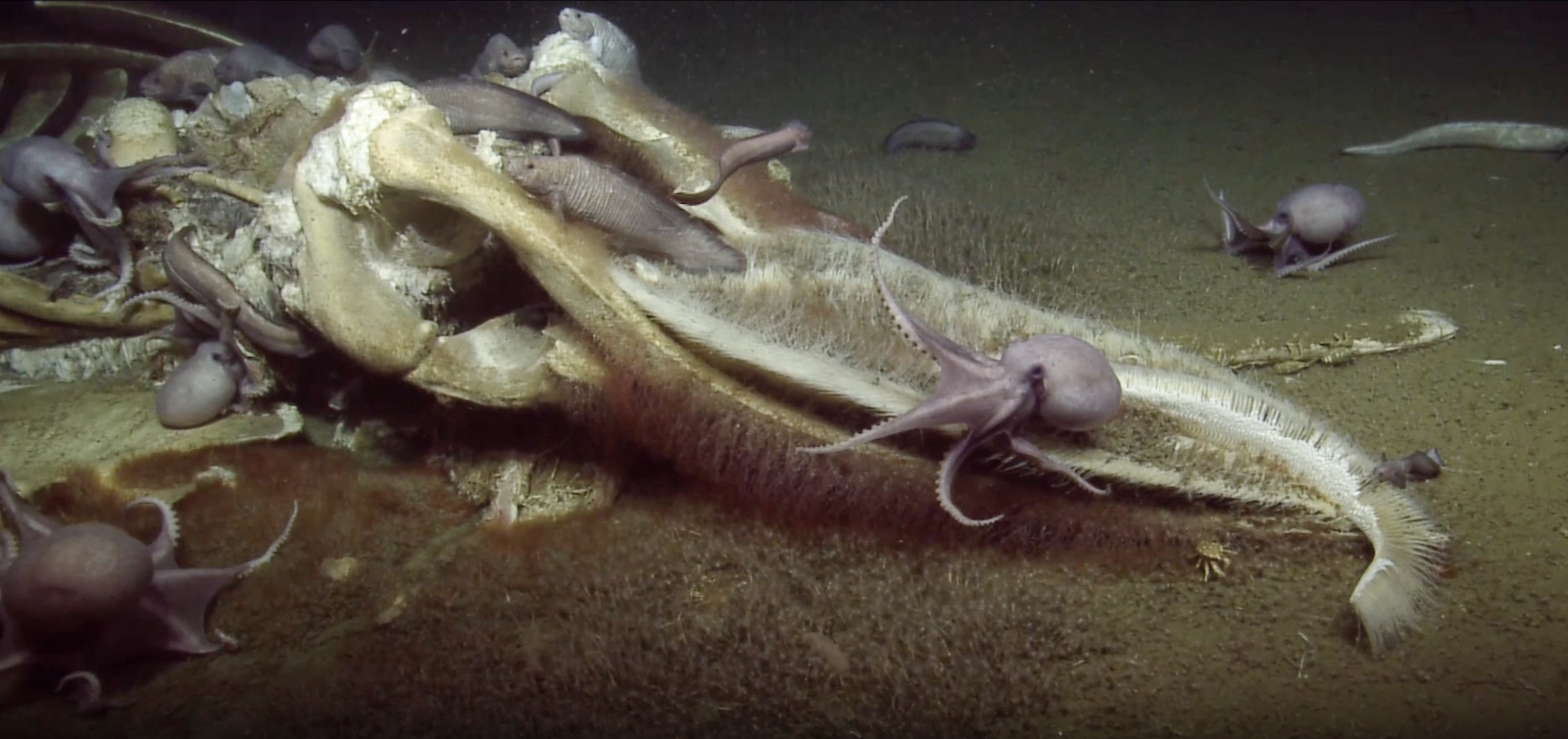
Whale falls provide a vital source of nutrients in the food-limited deep sea, sustaining diverse communities of organisms that can thrive around the remains for more than a decade. Photo Credit NOAA
Decomposition also proceeds much faster under the African sun than in the cold ocean depths. Although whale remains can persist for decades, an elephant’s soft tissues and even its bones may disappear within weeks. Nevertheless, its ecological influence can continue long afterward.
While scientists began studying whale falls in the late 1970s, research on large terrestrial carcasses remains relatively new. Over more than 15 years, the Kruger project grew from an investigation sparked by Thompson and Burkepile’s curiosity into a multidisciplinary initiative supported by the National Science Foundation. The team now studies everything from soil chemistry and microbes to vegetation, herbivores, predators and entire ecosystems.
The collaboration also involves conservation specialists, social scientists, communicators and creative professionals who have helped share the findings through projects such as a documentary. Midzi highlighted the essential role of park rangers, whose records of elephant deaths help researchers locate carcasses at different stages of decomposition.
One of the study’s most striking findings is the persistence of these changes. Smit explained that researchers could still detect an elephant’s influence in the soil and vegetation around eight years after its death, while herbivores continued to revisit the sites. Even at the oldest locations studied, nitrogen levels in grasses and grazing activity showed no clear decline. Meanwhile, reduced microbial and plant diversity had not fully recovered.
These findings demonstrate how ecosystems can retain the effects of past events even after their causes have disappeared. An elephant’s death may be brief as a visible event, but its consequences can remain embedded in the landscape for years.
Elephants and other large herbivores once inhabited vast areas across many continents. Their disappearance from numerous landscapes may have removed not only their influence as living animals but also the ecological processes associated with their remains.
Although the consequences for ecosystems without these animals remain uncertain, the Kruger research raises important questions about how the loss of megafauna may have changed nutrient cycling, vegetation and food webs.
Ultimately, an elephant’s ecological role extends beyond its lifetime. Through decomposition, nutrient redistribution and the responses of plants, microorganisms and grazing animals, a single carcass can reshape the savanna for years. Understanding these lasting effects offers a fuller picture of how large animals influence ecosystems—and how their absence continues to shape the natural world.
Adapted from original reporting by Harrison Tasoff, “Elephants continue to shape the savanna even after death,” The Current, UC Santa Barbara, 2026, in collaboration with Holly Ober at UCLA.