
Photo Credit: Alex Rose / Unsplash
How many sharks should a healthy coral reef have? It sounds like a simple question, but with few reefs left untouched by human activity, scientists have lacked a reliable baseline for understanding how much shark abundance has changed — or what recovery should look like.
An international team of researchers, led primarily by scientists at the Smithsonian Tropical Research Institute (STRI) in Panama and including researchers from UC Santa Barbara’s Marine Science Institute, has found an unusual way to answer it: look for “shark dandruff.”
Sharks are covered in tiny, tooth-like scales called dermal denticles, which they shed throughout their lives. These durable scales settle into reef sediments and can remain preserved for millions of years. By counting denticles in dated layers of sediment, researchers can estimate how many sharks once lived above those reefs.
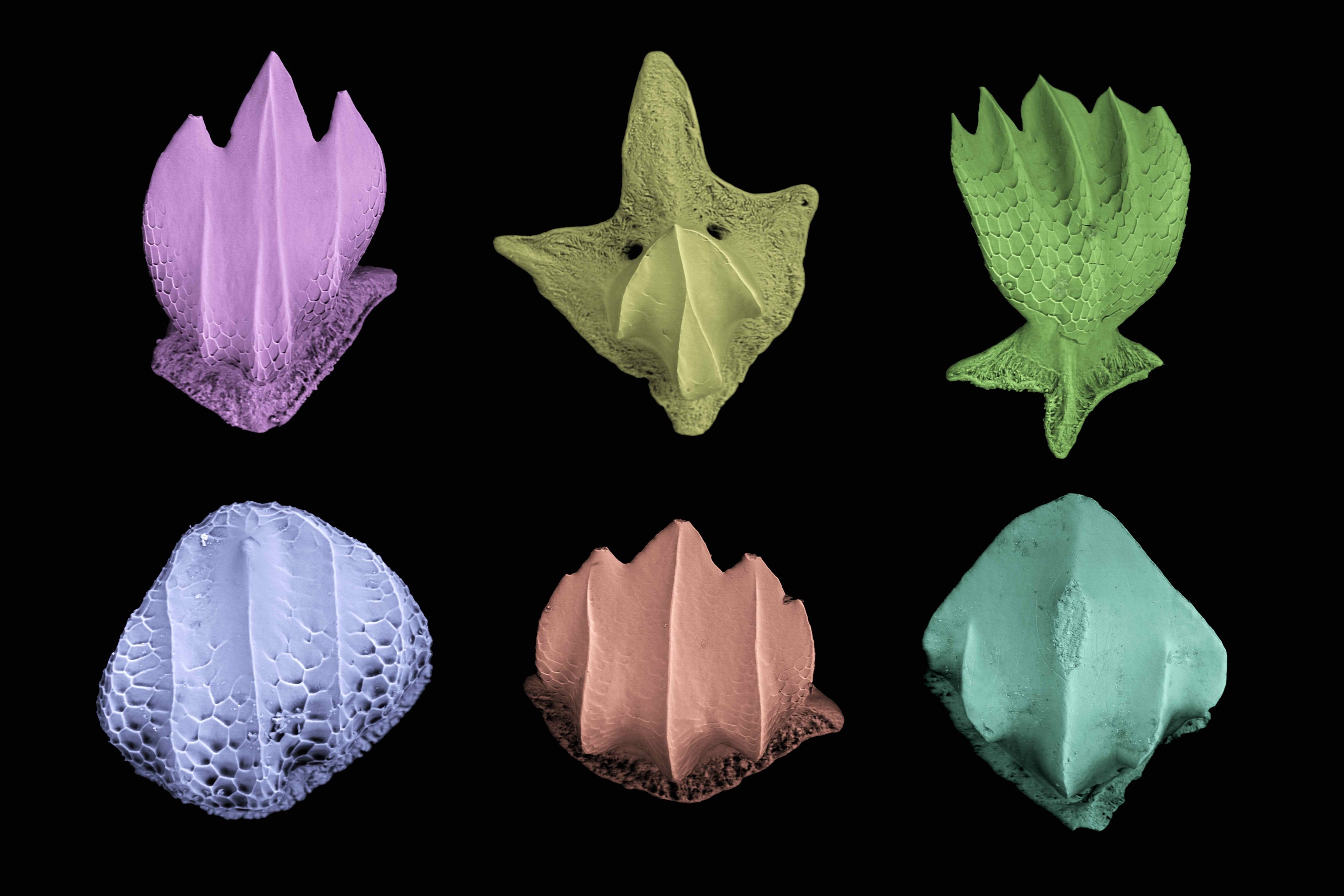
Distinctive shark denticles from six shark species, shown from top to bottom and left to right: Lemon shark (Negaprion brevirostris); Tiger shark (Galeocerdo cuvier); Great hammerhead (Sphyrna mokarran); Scalloped hammerhead (Sphyrna lewini); Caribbean reef shark (Carcharhinus perezi); and Nurse shark (Ginglymostoma cirratum). Photo Credit: Erin Dillon, Jorge Ceballos, Aaron O’Dea, & Ashley Diedenhofen
Featured on the cover of Science, the study was led by Erin Dillon, who began the research during her doctoral work at UC Santa Barbara before becoming a postdoctoral researcher at STRI. UC Santa Barbara’s Doug McCauley, a Principal Investigator at the Marine Science Institute and professor in the Department of Ecology, Evolution and Marine Biology, is a co-author.
McCauley says the work addresses a fundamental challenge in shark conservation. Sharks are essential to healthy ocean ecosystems, but overfishing, shark finning and habitat destruction have dramatically reduced their numbers. Conservationists have long struggled with a basic question: How many sharks should actually be in the ocean?
The researchers describe the denticle method as a kind of time machine, allowing scientists to look back at shark populations before humans substantially altered marine ecosystems.
The team compared sediments from both sides of Panama’s Isthmus, examining layers deposited 7,000 to 3,000 years ago, long before intensive fishing, alongside sediments from the past century. In 157 samples, they recovered 3,497 shark denticles.
The difference between the two coasts was striking. In Bocas del Toro on Panama’s Caribbean coast, researchers found about 50 denticles in 10 kilograms of reef sediment. Their first, much smaller Pacific sample contained about 200 denticles in just one kilogram.
As the researchers analyzed the full dataset, the pattern held. Before intensive fishing, reefs in the Gulf of Panama on the Pacific coast supported roughly 20 times as many sharks as reefs on the Caribbean side, despite the regions being only about 100 kilometers apart and sharing many of the same shark species.
The two coasts have diverged even further over time. Shark denticle accumulation in the Caribbean has fallen by about 75%, while current Pacific rates remain statistically similar to their prehistoric baseline. Today, Pacific reefs yield roughly 100 times more denticles than Caribbean reefs.
That result is particularly surprising because the Pacific coast has experienced much greater fishing pressure. More than 98% of Panama’s fishing occurs there.
The researchers point to ocean productivity as a major part of the explanation. Seasonal upwelling in the Gulf of Panama brings cold, nutrient-rich water to the surface, supporting abundant food for large predators. The Caribbean is more nutrient-poor, with more of its energy concentrated within reef biomass. That means lower natural shark abundance and greater vulnerability to fishing.
The shark denticle approach operates a little bit like a time machine, giving us a peek at how many sharks there used to be in these areas of the oceans – and what kinds of sharks were there.
The finding has important implications for conservation. Managers often use the healthiest nearby reef as a reference for determining how many sharks a damaged ecosystem should eventually support. But Panama shows why that can be misleading. Using the Pacific as a benchmark for the Caribbean could produce a recovery target wrong by an order of magnitude or more.
The researchers argue that ocean productivity should be considered alongside fishing history when setting conservation baselines and recovery goals.
The Pacific findings are not a clean bill of health, however. Targeted shark fishing in the Gulf of Panama intensified in the 1980s, and averaging data across a century could obscure more recent declines. Research by STRI scientist Héctor Guzmán also shows that Pacific shark populations remain under pressure from fishing.
Changing ocean conditions add another concern. The group reported last year that the nutrient-rich upwelling that fuels the Gulf of Panama failed for the first time on record. Together, overfishing and changing ocean conditions could push Pacific sharks toward ecological conditions not seen for millennia, despite their historically strong capacity to recover.
The research itself took more than a decade to develop. Dillon began the project as an intern at STRI in 2014 and continued it during her doctoral studies at UC Santa Barbara. The team had to determine what denticles could reveal, develop ways to extract them from reef sediments and learn how to interpret the fossil record.
Panama offered an extraordinary natural laboratory: two very different oceans separated by a narrow strip of land. The resulting record shows that even neighboring ecosystems can have dramatically different natural levels of shark abundance — an insight that could help scientists set more realistic goals for rebuilding shark populations around the world.
For UC Santa Barbara’s Marine Science Institute, the study highlights the value of looking deep into the past to understand the oceans of today. These tiny fossil scales provide a powerful new window into what healthy shark populations may have looked like — and what recovery might realistically mean.
Adapted from original reporting by Harrison Tasoff, “Two Oceans, One Country, 20 Times the Number of Sharks,” The Current, UC Santa Barbara, 2026, which was adapted from the original release “Sharks × Twenty,” Smithsonian Tropical Research Institute.