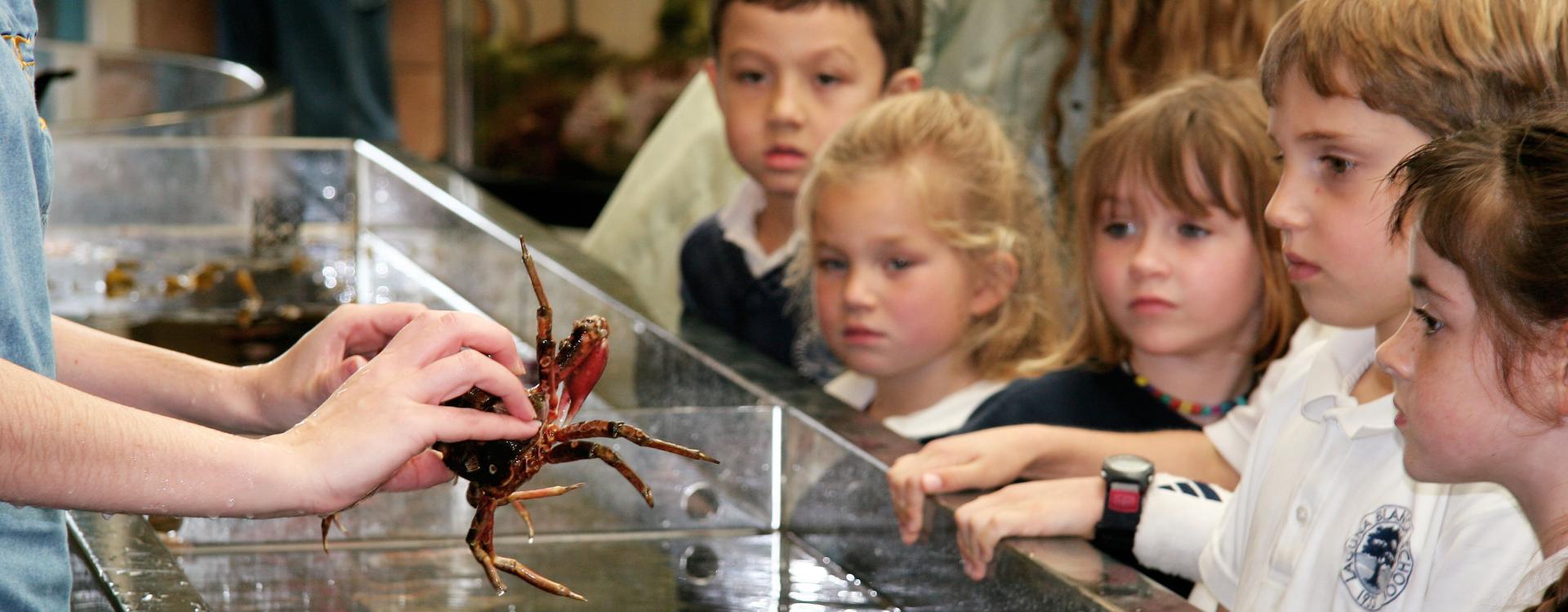
Kindergarten kids look attentively to a crab held by a docent over touch tank at The REEF. Photo Credit: Monica Pessino
Step into UC Santa Barbara’s REEF and it becomes clear that the ocean is full of character—seastars with attitude, spiky sea urchins, unexpectedly playful sharks, and even a bit of coastal folklore (some say touching a sea cucumber brings good luck). The Research Experience and Education Facility offers an immersive introduction to marine and environmental science, taking full advantage of its location just steps from Campus Point. Its modern touch tanks are filled with fresh seawater pumped directly from the Pacific and feature native species from nearby tide pools and kelp forest ecosystems. Other exhibits recreate habitats studied through UCSB’s long-term research sites along the California coast and in coral reef systems abroad.
For around 25 years, REEF has welcomed more than 250,000 visitors, helping spark curiosity about ocean life and, for many, inspiring future paths in marine science. For others, it offers a deeper understanding of and connection to coastal ecosystems.
Director Scott Simon describes the undergraduate student educators as the “heart and soul” of the REEF, emphasizing what an extraordinary resource the facility is—not only for research and education, but as a living system where students and the broader community can engage directly with marine science. He highlights REEF as an exceptional opportunity for hands-on learning, where real-world experience with living organisms turns classroom concepts into something tangible and immediate.
Undergraduate educator Summer Baars also brings the facility to life through guided tours of the aquaria, introducing visitors to its most memorable residents. Among them is Boris, a California spiny lobster and the largest animal at REEF, estimated to be 85–90 years old. She also highlights the California moray eel known as “Love,” a name inspired by the pronunciation of “a moray” as “amore,” the Italian word for love.
Beyond its exhibits, REEF functions as an active research space where UCSB faculty and students conduct ongoing studies. These include investigations into marine heatwaves that affected local waters between 2014 and 2016, as well as aquaculture research. The facility also supports conservation efforts as one of the breeding sites for the White Abalone Restoration Consortium, a collaborative program working to restore the endangered white abalone to wild populations.
As part of UCSB’s Marine Science Institute, REEF offers educational programs for all ages, from elementary school students to adults. Programming includes interactive visits, remote learning opportunities, citizen science projects, and professional development for educators. A weeklong summer camp also provides younger learners with a deeper introduction to ocean science.
REEF is free and open to the public, with regular open hours typically on Fridays from 3:00 p.m. to 5:00 p.m. and Saturdays from 11:00 a.m. to 3:00 p.m. To confirm hours or schedule a visit, contact outreach@msi.ucsb.edu or call (805) 893-8765. More information is available on the REEF website, along with additional educational content on its YouTube channel.
Adapted from reporting by Sonia Fernandez, “Beyond the Classroom: The Research Experience and Education Facility (REEF),” The Current, UC Santa Barbara, 2026.