
Armand Kuris, left, UCSB Marine Science Institute parasitologist, with student Sophia Lecuona Manos, right, one of the undergraduates who discovered a new crab egg predator. Photo Credit: Matt Perko
A remarkable team of UC Santa Barbara undergraduate students has made a groundbreaking discovery: a previously unreported egg predator of rock crabs on the West Coast of the Americas. Led by undergraduates Sophia Lecuona Manos, Gabrielle Plewe, Carson Gadler, and Jaden Orli, with graduate mentor Zoe Zilz, the work emerged from the lab of Ecology, Evolution, and Marine Biology Professor Armand Kuris, a UCSB parasitologist and Principal Investigator at the Marine Science Institute.
What began as routine lab instruction quickly became a major scientific contribution. The students identified a tiny crustacean—a nicothoid copepod—living within the egg broods of local rock crabs. Unlike typical parasites, it feeds directly on crab eggs, raising concerns for fisheries that depend on species such as yellow, Pacific, and red rock crabs.
“It was surreal,” said Lecuona. “It gave me experiences that I wouldn’t have at that point that I could take into grad school.” Orli added: “Unlike a parasite that might weaken its host gradually, an egg predator strikes at the next generation directly.”
Over two years, the team collected crabs from local waters with help from community fishers and studied them in UCSB’s seawater labs. Some crabs were heavily infested, with juvenile copepods covering their gills. The researchers found that the organism completes its entire life cycle on crab egg broods, with females ateaching permanently and reproducing in sync with the host, while juveniles reinfest future broods.

An adult female of the recently discovered nicothoid copepod (dark orange), lives in, feeds off and lays its own eggs (pink) in the developing egg brood (orange spheres) of female crabs. Courtesy Image
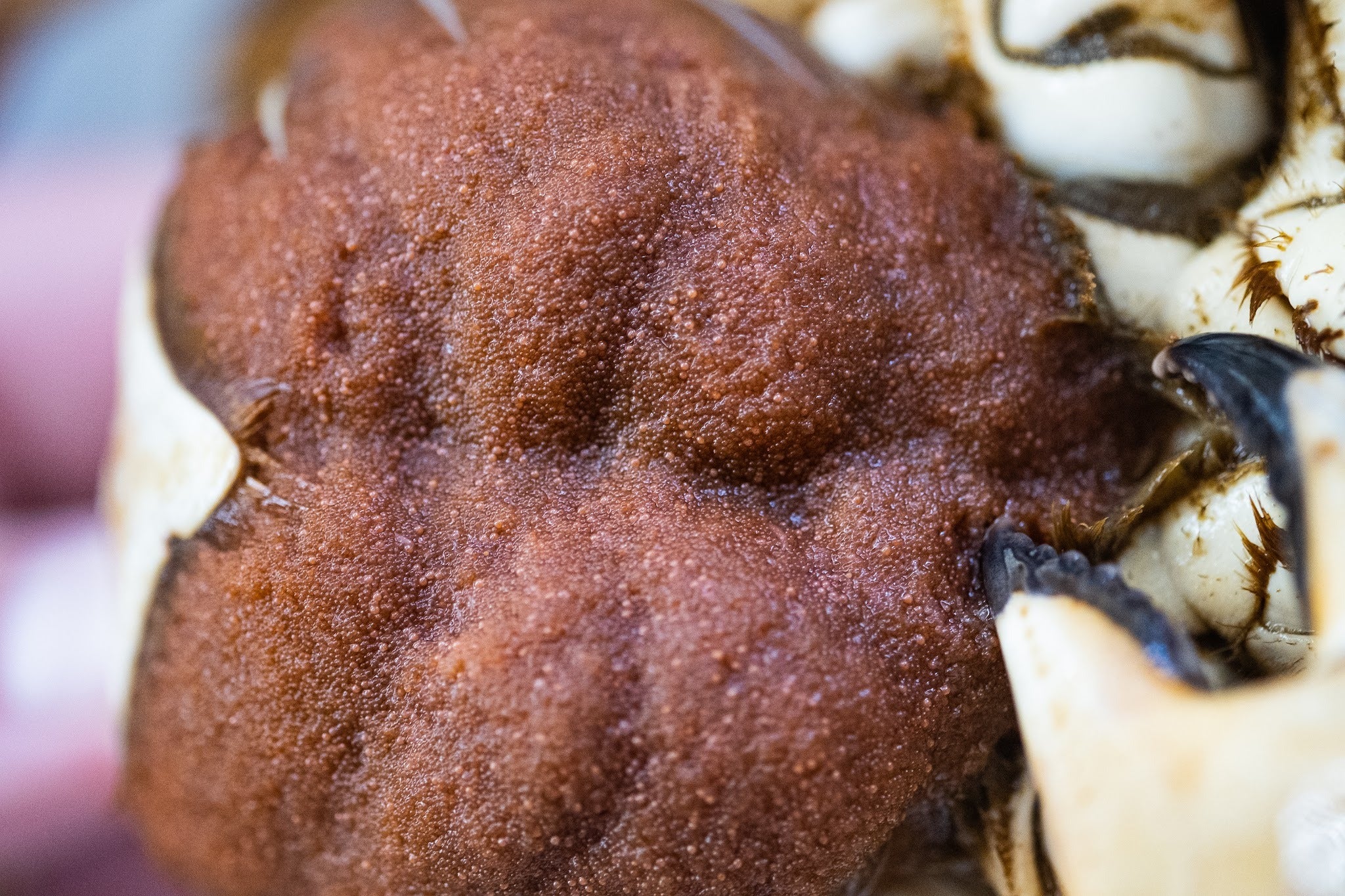
A carb egg brood infested with nicothoid copepods (the larger, slightly brighter spheres). Courtesy Image
The students also documented the copepod’s life cycle, from a microscopic nauplius larva to a fast-swimming juvenile. Only females were observed on crabs, suggesting males may exist elsewhere. Because crab embryos develop in a highly fixed way, even minor egg damage can cause developmental failure—giving this tiny predator an outsized ecological impact.
The copepod was found on multiple commercially important species, though its presence in regulated Dungeness crabs remains unknown.

This painstaking work culminated in publication in the prestigious journal Ecology, which featured the study with a cover photo and high editorial praise:
The life cycles of organisms is natural history's greatest theoretical contribution to ecology. Your discovery of a previously unknown copepod parasitizing the egg masses of rock crabs, your detailed description of its life cycle, and your careful follow-up to your initial serendipitous observation fall within the best tradition of natural history. This paper opens up many new avenues of research… A very nice paper.”
—Prof. John Pastor, Subject-matter Editor, Ecology
In my roughly 180-publication experience no other editor has ever lavished such praise.
For the students, the project has been transformative, turning them into leading experts on a newly documented species. Kuris underscored the broader implications: “The team found it on three different rock crabs that are commercial species, but we don’t know about the Dungeness crab… We are worried.”

Students who studied the crab egg predator, from top left: undergraduates Yinghui Wang, Dakota Tyson, Sawyer Kennedy, Isabella Check, Annika Sullivan and Nathaniel Price. Bottom row: Undergraduates Sophia Lecuona Manos (co-author) and her dog Davey, Gabrielle Plewe, graduate student and mentor Zoe Zilz holding a yellow rock crab and her dog Juniper; undergraduate Jaden Orli (lead author) and undergraduate Julia Vaughan. Not pictured: Carson N. Gadler (co-author).
The research also underscores UCSB’s commitment to high-level undergraduate research. Students led the fieldwork, analyzed specimens, and contributed to a paper recognized for its scientific rigor and ecological significance. Their work demonstrates how hands-on mentorship and curiosity-driven research can produce findings with both scientific and real-world impact.
Many questions remain: Where are the male nicothoids? How did the species arrive on the Pacific Coast? Are there unknown ecological consequences? New student researchers are now carrying the work forward, continuing to study this tiny but influential predator.
Adapted from reporting by Sonia Fernandez, “UCSB students discover new crab egg predator,” The Current, UC Santa Barbara, 2026.