
Eagle Mountain Pump Plant, Ten miles north of Route 10, southeast of Eagle Mountain, Eagle Mountain, Riverside County, CA. Photo Credit: Jet Lowe / U.S. Library of Congress
A recent study published in the journal Science highlights how some regions have successfully reversed groundwater depletion, offering practical lessons for communities facing declining water supplies.
Around half of the world’s population relies on groundwater for drinking, and it supports roughly 40% of global irrigation. Yet more than a third of aquifers are shrinking. Falling water tables can intensify drought risk, cause land subsidence and increase the risk of seawater intrusion, while also damaging ecosystems and limiting access to water. Safeguarding this resource is therefore essential for environmental stability and human well-being.
Encouragingly, there are examples of recovery. An analysis of 67 cases of aquifer rebound found that success typically involved combining multiple strategies rather than relying on a single solution. In most cases, communities supplemented groundwater with alternative water sources, reducing pressure on depleted reserves and showing that decline is not inevitable.

The study was led by Scott Jasechko, a professor of water resources at the University of California, Santa Barbara’s Bren School of Environmental Science & Management and a principal investigator at the UC Santa Barbara Marine Science Institute. His work demonstrates how different regions have restored groundwater levels through a mix of policy, infrastructure and environmental management.
Building on earlier global assessments of nearly 1,700 aquifers, the research identified three main approaches: developing alternative water supplies, implementing regulations and market-based policies to reduce demand, and artificially replenishing aquifers. These strategies are often used together. Like a bank account, aquifers are replenished by rainfall and surface water, but excessive withdrawals can quickly deplete them—so recovery depends on reducing withdrawals, increasing recharge or both.
Most successful cases involved multiple interventions, underscoring the value of integrated strategies. Alternative water sources appeared in over 80% of cases. While effective, they can be costly and may shift environmental pressures elsewhere. Policy measures directly address overuse and are generally less energy-intensive, though they can affect local economies. Artificial recharge can restore water levels without reducing demand, but it requires both energy and a reliable water source.
The study also highlights several key lessons: combining approaches improves outcomes, reducing groundwater extraction is often essential, and policies must be effectively enforced. Recovery timelines vary—some aquifers rebound within a few years, while others require gradual, long-term efforts. Gains can also be reversed, making continued monitoring crucial. Managing water quality alongside quantity and accounting for climate change are equally important.
Real-world examples illustrate these principles. In Beijing, decades of heavy pumping caused groundwater levels to drop sharply. A combination of imported water, wastewater reuse and restrictions on pumping helped restore levels, reduce land subsidence and revive dried-up springs.
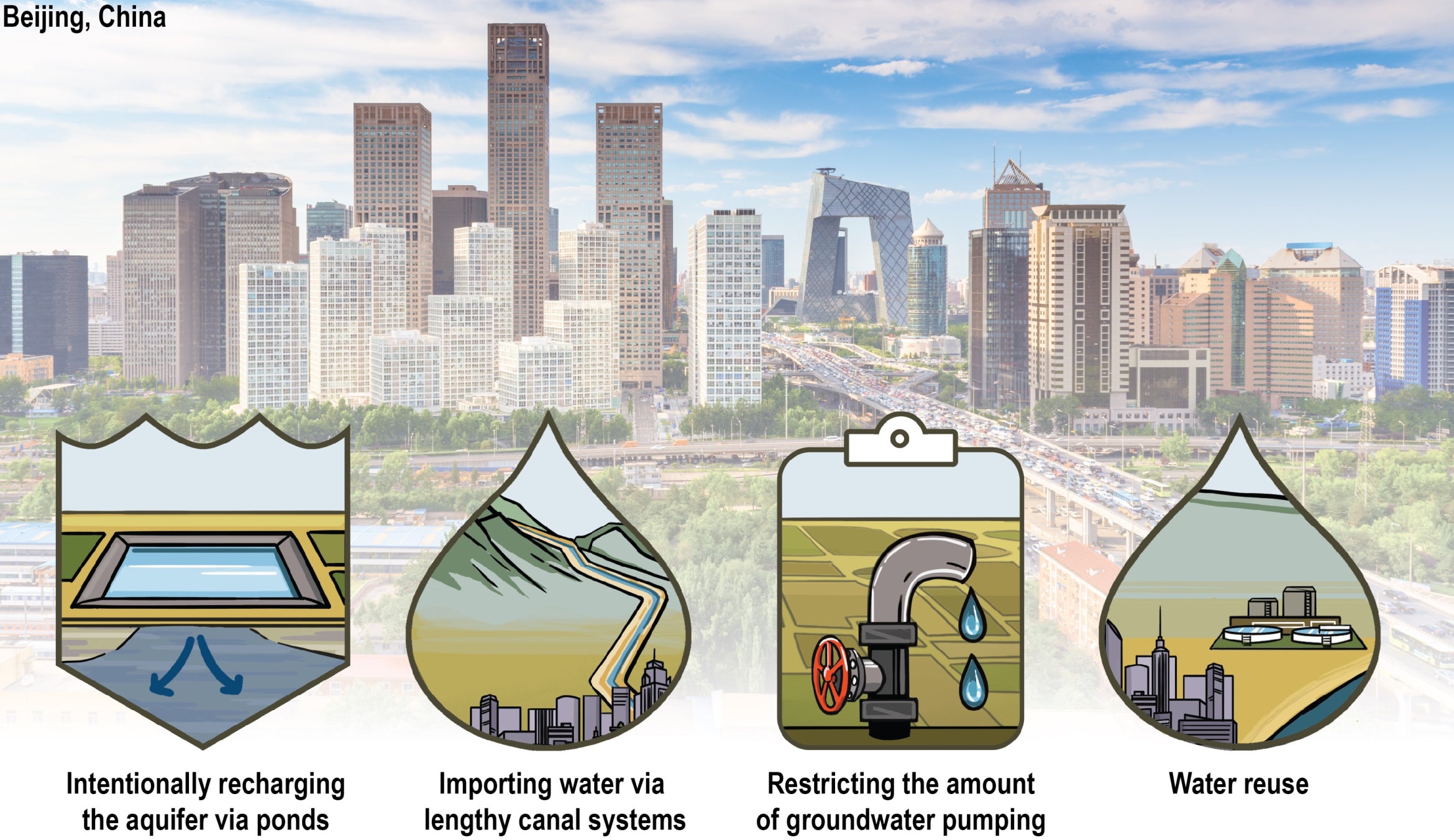
By selecting several interventions from a menu of strategies, Beijing was able to reverse their declining groundwater. Credit: J. Spahr and Scott Jasechko
However, recovery can be fragile. In Green Bay, Wisconsin, an initial effort to supplement groundwater helped restore levels temporarily, but rising demand led to renewed decline. A later expansion of the system helped stabilize the aquifer again, highlighting the need for ongoing management and adaptation.
Although the study is based on previously documented cases and may not apply everywhere, it offers a valuable set of strategies that can be adapted to local conditions. Overall, it shows that with coordinated action and long-term planning, groundwater depletion can be reversed.
Adapted from reporting by Harrison Tasoff, “Why some regions are winning the fight against groundwater depletion,” The Current, UC Santa Barbara, 2026.