In Chile, a major program returning land to the Mapuche has strengthened their ability to determine how their territories are used, while producing more mixed environmental results.
Tiny fossil scales reveal that ancient Pacific reefs supported 20 times more sharks than Caribbean reefs — offering a surprising new baseline for shark conservation.
Research from UC Santa Barbara and UC Santa Cruz found that replacing a gasoline-powered vehicle with a battery electric vehicle (BEV) almost always reduces lifetime greenhouse gas emissions.
A new study conducted by researchers from the University of California Santa Barbara, The Nature Conservancy and Renmin University of Chinahas combined fisheries, trade and policy data to investigate whether shark-finning regulations influence global trade.
A new study examining corporate zero-deforestation and conversion (ZDC) commitments finds that voluntary initiatives were not the main factor associated with recent reductions in forest loss within palm oil supply chains.
Long-term research finds that the amount of kelp surviving winter storms has a greater influence on giant kelp productivity than resource availability.
A new statewide assessment by researchers at the University of California, Santa Barbara and collaborating institutions has found that California has lost approximately 60% of its coastal sand dune systems since 1850.
The renewed investment expands opportunities for UCSB students and researchers to advance environmental solutions through research, mentorship, and professional development.
A new study published in Nature by researchers from the University of Utah, UC Santa Barbara and several partner institutions found that carbon markets may be underestimating the likelihood of future carbon losses in U.S. forests.
Researchers at UC Santa Barbara’s Benioff Ocean Science Laboratory and regional partners deploy thermal imaging and artificial intelligence to protect migrating gray whales.
Researchers from UC Santa Barbara’s Benioff Ocean Science Laboratory and global partners met to address whale–ship collisions, noting that thousands of whales may be killed annually and exploring solutions such as ship slowdowns, route changes, and detection tools.
UC Santa Barbara researchers show that kelp forests strongly influence nearby beaches by supplying nutrients through kelp washed ashore, shaping food webs from small invertebrates to shorebirds and linking ocean and coastal ecosystems.
UC Santa Barbara Marine Science Institute celebrates Dr. Alice Alldredge’s election to the American Academy of Arts and Sciences, honoring her transformative impact on ocean science.
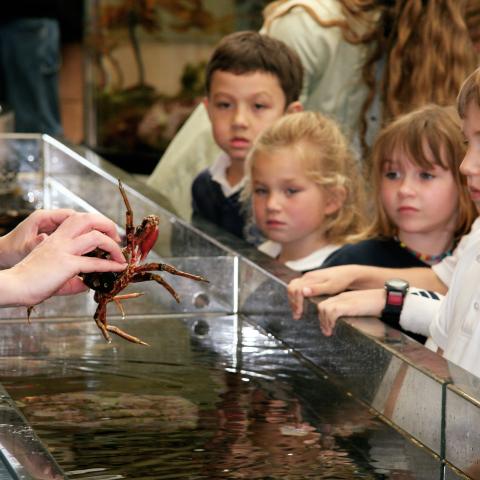
For around 25 years, REEF has welcomed more than 250,000 visitors, helping spark curiosity about ocean life and, for many, inspiring future paths in marine science.
A powerful new episode of Planet Visionaries, a landmark podcast series created in partnership with the Rolex Perpetual Planet Initiative and National Geographic, dives deep beneath the ocean’s surface to uncover an invisible force shaping life on Earth.